
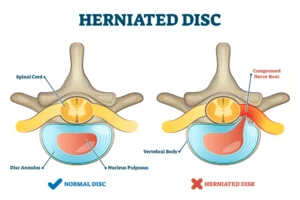
 If your doctor or chiropractor has mentioned a disc bulge or herniation, you probably walked out of that appointment with more questions than answers. What exactly is the difference? Which one is more serious? And what does it actually mean for how you should be treated? At Dohrmann Chiropractic in Kansas City, these are among the most common questions we hear — and Dr. Ben Dohrmann has spent more than 17 years helping patients in Kansas City, Gladstone, Parkville, Liberty, and Smithville understand exactly what is happening in their spine and what to do about it without resorting to surgery.
Your Spinal Discs: A Quick Primer
Between each vertebra in your spine sits a spinal disc — a tough, fibrous outer ring (called the annulus fibrosus) surrounding a soft, gel-like center (the nucleus pulposus). These discs act as shock absorbers, allow spinal movement, and keep the vertebrae properly spaced. When they function well, you barely notice them. When they don’t, the pain can be life-altering.
Disc problems are more common than most people realize. Whether you lift something awkwardly, sit at a desk for years, sustain an injury, or simply experience the natural changes that come with age, your discs can shift, compress, or tear — leading to a bulging disc, a herniated disc, or related conditions like disc protrusion. Understanding the distinction between these conditions is the first step toward getting the right treatment.
What Is a Bulging Disc?
A bulging disc occurs when the outer wall of the disc weakens and the disc expands beyond its normal boundary — think of it like a hamburger patty that is too wide for its bun. The disc’s outer shell remains intact, but it protrudes outward, potentially pressing against nearby nerves or the spinal cord.
Bulging discs are sometimes described as the earlier or less severe end of the disc problem spectrum, but that doesn’t mean they are harmless. Depending on the degree of protrusion and the location in the spine, a bulging disc can cause significant pain, stiffness, limited range of motion, and radiating symptoms into the arms or legs.
Common symptoms of a bulging disc include:
- Dull, aching pain in the low back or neck
- Pain that worsens with prolonged sitting or bending
- Stiffness that improves slightly with movement
- Mild tingling or numbness that comes and goes
What Is a Herniated Disc?
A herniated disc — also called a ruptured disc or slipped disc — occurs when the outer wall of the disc actually tears or cracks, allowing some of the inner gel material to push through. This is a more advanced form of disc damage, and the escaped disc material can directly compress or irritate spinal nerves with much greater intensity than a simple bulge.
When that nerve compression occurs in the lower back, it can trigger sciatica — the sharp, burning, or shooting pain that radiates from the lower back down through the hip, buttock, and leg. A herniated disc in the cervical spine (neck) can send similar symptoms down the arm, creating what is commonly called a pinched nerve.
Common symptoms of a herniated disc include:
- Sharp, stabbing, or burning pain — often on one side
- Radiating pain into the leg (sciatica) or arm
- Significant numbness or tingling in the extremities
- Muscle weakness in the affected limb
- Pain that worsens sharply with coughing, sneezing, or straining
Disc Bulge vs. Herniated Disc: The Key Differences at a Glance
While both conditions fall under the broader category of disc problems, here is how they differ in terms of structure, severity, and symptoms:
| Feature | Disc Bulge | Herniated Disc |
|---|---|---|
| Outer wall (annulus) | Intact but weakened | Torn or cracked |
| Inner material (nucleus) | Contained within disc | Leaks or protrudes outward |
| Nerve irritation | Possible pressure | Direct compression or chemical irritation |
| Pain severity | Mild to moderate | Moderate to severe |
| Radiating symptoms | Less common | More common (sciatica, arm pain) |
| Responds to non-surgical care | Frequently | Often, with the right protocol |
The important takeaway: both conditions are treatable without surgery in the majority of cases. At Dohrmann Chiropractic, we evaluate each patient individually to determine the nature and extent of their disc problem before building a customized care plan.
Why Accurate Diagnosis Matters — And Why We Use Digital X-Ray
Many patients come to us having been told they have a “bad disc” without a clear picture of what that actually means for their spine. That lack of clarity makes it nearly impossible to develop an effective treatment plan.
That’s why Dr. Dohrmann and his team use on-site digital X-ray imaging to evaluate spinal alignment, disc spacing, vertebral positioning, and other structural markers — right here in our Kansas City office, without sending you across town for an outside referral. The faster we can see what’s happening, the faster we can start treatment that’s actually matched to your anatomy.
Dr. Dohrmann has a uniquely personal connection to this process. At age 23, he was diagnosed with degenerative disc disease in his own lower back. He lived with chronic low back pain before finding relief through chiropractic care — which ultimately inspired him to dedicate his career to helping others navigate exactly these kinds of spinal challenges. That lived understanding drives how our team approaches every case.
Non-Surgical Treatment Options for Disc Problems in Kansas City
At Dohrmann Chiropractic, we offer a comprehensive, non-surgical approach to both bulging and herniated discs. Our treatment protocols are designed to reduce nerve compression, promote disc healing, and restore pain-free function — without drugs or surgery.
Spinal Decompression with the DRX9000
The DRX9000 is a specialized spinal decompression system that gently and precisely separates the vertebrae, creating negative intradiscal pressure. This negative pressure acts like a vacuum that draws the displaced disc material back toward its proper position while pulling in nutrients and fluids needed for healing. Spinal decompression is one of the most effective non-surgical interventions available for both disc bulges and herniations, and it is a centerpiece of our treatment approach at Dohrmann Chiropractic.
SoftWave Therapy (Shockwave Tissue Regeneration)
We often pair spinal decompression with SoftWave therapy — an FDA-cleared technology that uses electrohydraulic supersonic acoustic waves to stimulate tissue regeneration at the cellular level. SoftWave can reduce inflammation around irritated nerves, promote blood flow to the injured disc area, and accelerate the body’s own healing response. It is non-invasive, requires no downtime, and is trusted by institutions including the Mayo Clinic, Cleveland Clinic, and Walter Reed Military Center.
The DRX9000 + SoftWave combination protocol has produced outstanding outcomes for our disc patients in Kansas City — results that go well beyond temporary symptom relief.
Chiropractic Adjustments
Targeted chiropractic adjustments restore proper spinal alignment, reduce mechanical stress on the affected disc, and help reestablish normal nerve function. Our three-doctor team — Dr. Ben Dohrmann, Dr. Kevin McFadden, and Dr. Frank Siraguso — brings over 46 years of combined clinical experience to every adjustment, ensuring the technique is appropriate for your specific disc condition and severity.
When Should You See a Chiropractor for a Disc Problem?
Don’t wait until the pain is unbearable. The earlier a disc problem is addressed, the better the outcomes — and the less likely the condition is to progress. You should schedule an evaluation with our Kansas City team if you are experiencing any of the following:
- Persistent back or neck pain lasting more than a few days
- Pain that radiates into your arm, hand, hip, or leg
- Numbness or tingling that doesn’t resolve
- Weakness in an arm or leg
- Pain that worsens when sitting, bending, or during certain movements
- You’ve been told surgery may be necessary for your disc
Being told surgery is your only option doesn’t make it true. Many of our Kansas City patients — including those referred for surgical consultations — have found significant, lasting relief through our non-surgical protocols.
Serving Kansas City, Gladstone, Parkville, Liberty, and Smithville
Dohrmann Chiropractic is conveniently located to serve patients throughout the greater Kansas City area, including Gladstone, Parkville, Liberty, Smithville, and the Clay and Platte County communities. With over 600 five-star Google reviews and more than 17 years of serving the Kansas City area, our team is the trusted choice for non-surgical disc treatment in north Kansas City.
Ready to find out what’s really happening with your spine? Call or text us at (816) 436-5520 or visit us at 9576 N McGee St, Kansas City, MO 64155.
Office Hours:
Monday–Friday: 9am–12pm & 2:30pm–5:30pm
Saturday: 9am–12pm
Frequently Asked Questions: Disc Bulge & Herniation in Kansas City
What is the difference between a disc bulge and a herniated disc?
A disc bulge means the outer wall of the disc is intact but has expanded beyond its normal boundary. A herniated disc means the outer wall has actually torn, allowing the inner gel material to push through. Herniations typically cause more severe and radiating symptoms, though both conditions can cause significant pain and both can respond well to non-surgical treatment.
Can a bulging or herniated disc heal on its own?
Some disc problems can improve with conservative care and time, but waiting without treatment often allows the condition to worsen — especially if daily habits like prolonged sitting or poor posture are contributing. Proactive, targeted treatment with spinal decompression, SoftWave therapy, and chiropractic adjustments significantly accelerates healing and reduces the risk of progression.
Is spinal decompression effective for disc herniations?
Yes. The DRX9000 spinal decompression system used at Dohrmann Chiropractic creates negative intradiscal pressure that draws the herniated disc material back toward its proper position while improving nutrient flow to the damaged disc. This mechanism is one of the most clinically supported non-surgical interventions available for both bulging and herniated discs.
How do I know if I have a disc bulge or herniation without an MRI?
A thorough clinical examination combined with digital X-ray imaging — available on-site at Dohrmann Chiropractic — can reveal critical information about disc spacing, spinal alignment, and structural changes that indicate disc involvement. While an MRI provides soft-tissue visualization, Dr. Dohrmann uses clinical findings and X-ray analysis to develop effective treatment plans and determine when additional imaging may be appropriate.
Can sciatica be caused by a bulging or herniated disc?
Yes — both can. Sciatica occurs when a disc problem in the lower lumbar spine compresses or irritates the sciatic nerve. A herniated disc is a more common driver of classic sciatica symptoms, but a significant bulge at the right location can produce the same shooting pain, numbness, and tingling down the leg.
What is the difference between a disc protrusion and a herniation?
A disc protrusion is technically a type of herniation where the disc material extends outward but the base of the protrusion is still wider than the protruding portion. It sits between a classic bulge and a full herniation on the spectrum of disc displacement. All three — bulge, protrusion, and herniation — can be addressed through the same non-surgical protocols at Dohrmann Chiropractic.
How many sessions of spinal decompression are typically needed?
Treatment plans vary depending on the severity of the disc problem, the patient’s overall spinal health, and how long the condition has been present. Many patients begin experiencing meaningful relief within the first several sessions. Dr. Dohrmann evaluates each patient individually and builds a customized plan rather than applying a one-size-fits-all protocol.
Do you treat disc problems in the neck as well as the lower back?
Yes. Disc bulges and herniations can occur anywhere along the spine — including the cervical spine in the neck — and can cause radiating symptoms into the arm, hand, and shoulder. Dohrmann Chiropractic treats both cervical and lumbar disc conditions using targeted adjustments, spinal decompression, and SoftWave therapy, tailored to the specific location and nature of the disc problem.
Schedule Your Disc Evaluation in Kansas City
You don’t have to keep living with the pain, stiffness, or nerve symptoms that come with a disc problem — and you don’t have to accept surgery as your only path forward. Dr. Ben Dohrmann and the team at Dohrmann Chiropractic are here to evaluate your spine, explain exactly what is happening, and build a customized plan to get you back to doing what you love.
Call or text us at (816) 436-5520, visit our office at 9576 N McGee St, Kansas City, MO 64155, or learn more about our disc bulge and herniation treatment in Kansas City. Walk-ins are welcome.