
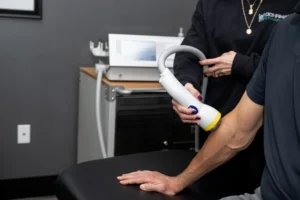
 If you’ve been dealing with heel pain that won’t quit, a shoulder that aches every time you reach overhead, a knee that protests every time you climb stairs, or elbow pain that’s ruining your golf game or your tennis serve — and nothing has made it stop for good — there’s a specific reason for that. Tendons are among the most frustratingly slow-healing tissues in the human body, and most of the treatments people try don’t address why. At Dohrmann Chiropractic in Kansas City, SoftWave shockwave therapy is changing that equation for active adults, athletes, and patients who’ve been told surgery may be their only remaining option. Here’s what’s actually happening in your tendon — and why SoftWave works when everything else hasn’t.
The Real Reason Tendon Injuries Are So Stubborn
Most people assume that if they rest long enough, a painful tendon will eventually heal. Sometimes it does. But for a significant portion of tendon injuries — particularly those that have been aggravated, reinjured, or simply ignored for months or years — rest alone doesn’t get the job done. The reason comes down to biology.
Tendons connect muscle to bone and are built for strength and resilience, not for rapid repair. Unlike muscles, which have a rich blood supply to deliver oxygen and nutrients for healing, tendons are relatively avascular — meaning blood flow through tendon tissue is sparse compared to most other structures in the body. When a tendon is acutely injured, the initial inflammatory response brings some healing cells to the area, but in chronic tendon conditions — a category called tendinopathy — the tissue transitions away from active healing and into a degenerative state instead.
In tendinopathy, the organized collagen fibers that give a healthy tendon its strength become disorganized and weakened. The tendon develops areas of microscopic breakdown. Blood vessel formation is inadequate. The nervous system registers pain not from acute inflammation but from this degenerative, under-healed tissue — which is why it can hurt constantly even when you haven’t done anything to re-injure it recently.
This is why stretching, icing, and resting a chronic tendon injury often produces only temporary improvement. You’re managing symptoms without addressing the underlying tissue problem. And it’s exactly the problem that SoftWave therapy is engineered at the biological level to solve.
How SoftWave Therapy Solves the Tendon Healing Problem
SoftWave technology uses electrohydraulic supersonic acoustic waves — broad-field sound waves that penetrate deep into soft tissue — to trigger the specific biological responses that chronically injured tendons lack. When those waves pass through damaged tendon tissue, several things happen simultaneously that ordinary conservative care simply cannot replicate.
First, SoftWave stimulates angiogenesis — the formation of new blood vessels in the treated area. This is the single most important mechanism for tendon recovery, because new blood vessels bring the circulation that degenerative tendon tissue is starved of. Oxygen, growth factors, and healing cells can finally reach the injury site in meaningful quantities. This is what initiates real tissue repair rather than just symptom suppression.
Second, SoftWave activates resident stem cells near the treatment site. These are cells your body already possesses but which remain dormant in chronic injury states. The acoustic waves signal them to differentiate into the specific cell types needed to lay down new, organized collagen — the structural protein that restores tendon integrity and mechanical strength.
Third, the treatment helps break down and remodel disorganized scar tissue and calcific deposits that can develop in chronically injured tendons over time. This is especially significant for conditions like calcific shoulder tendinitis, where calcium deposits within the tendon contribute to pain and restricted movement.
The result is not pain relief that fades when the treatment stops. It’s actual tissue regeneration — measurable, progressive recovery of tendon structure and function — driven by your own body’s biology, with SoftWave providing the stimulus that years of conservative care couldn’t.
Tendon Conditions SoftWave Treats in Kansas City
Tendinopathy shows up across the body in predictable locations, and SoftWave is effective across all of them. Here are the conditions our patients in Kansas City, Gladstone, Parkville, Liberty, and Smithville most commonly come in to treat:
Plantar Fasciitis and Achilles Tendinopathy
Plantar fasciitis — the stabbing heel pain that hits hardest with those first steps out of bed in the morning — is one of the most studied applications of shockwave therapy, with strong research support for its effectiveness. The plantar fascia is a thick band of tissue that runs along the bottom of the foot from the heel bone to the toes. When it becomes chronically irritated, it develops the same degenerative tissue changes seen in tendinopathy. SoftWave stimulates healing in both the plantar fascia and the Achilles tendon at the heel, making it effective for patients with foot pain and numbness that has persisted despite months of stretching, orthotics, and physical therapy.
Rotator Cuff and Shoulder Tendinopathy
The rotator cuff is a group of four tendons that stabilize the shoulder joint, and rotator cuff tendinopathy is one of the most common sources of chronic shoulder pain in adults over 40. Overhead athletes — swimmers, baseball players, tennis players, golfers — are especially prone to it, but so is anyone who works at a desk with poor posture or lifts repeatedly at work. Calcific tendinitis, where calcium deposits form within the supraspinatus tendon, responds particularly well to SoftWave’s ability to break down and remodel those deposits while simultaneously stimulating tissue regeneration.
Patellar Tendinopathy (“Jumper’s Knee”)
The patellar tendon connects the kneecap to the shinbone and takes enormous load during jumping, running, and squatting. Active adults and athletes — runners, basketball players, volleyball players, CrossFit participants — develop patellar tendinopathy when this tendon is repeatedly stressed faster than it can recover. The resulting pain directly below the kneecap is often dismissed as “knee pain,” but it’s a specific tendon problem that responds very differently to treatment than arthritis or meniscus issues, and SoftWave is well-suited to the biological mechanisms at play.
Tennis Elbow and Golfer’s Elbow
Lateral epicondylitis (tennis elbow) and medial epicondylitis (golfer’s elbow) are both tendinopathy conditions of the forearm tendons that attach at the elbow. Despite their names, you don’t need to swing a racket or club to develop them — repetitive computer use, manual work, and gripping activities are equally common triggers. For golfers and tennis players in the Kansas City area, these conditions are both a nuisance and a threat to performance, and SoftWave offers a path to recovery that doesn’t require putting down the club or the racket for months at a time.
Hip Tendinopathy and IT Band Syndrome
Runners and cyclists commonly develop tendinopathy around the hip — gluteal tendinopathy, iliotibial band syndrome, and hip flexor issues — that can make training impossible and persist stubbornly even with rest. SoftWave’s ability to stimulate tissue repair and reduce chronic inflammation in these areas makes it a valuable tool for active patients who want to return to training without resorting to cortisone injections or surgical debridement.
Why an Olympic Team Chiropractor Chose to Bring SoftWave to Kansas City
Dr. Ben Dohrmann served as an Olympic Team Chiropractor at the London 2012 Summer Olympics — one of the highest-level sports medicine roles in his profession, working with elite athletes whose careers depended on recovering from soft tissue injuries as completely and quickly as possible. At that level, tissue regeneration isn’t theoretical. It’s a competitive necessity.
That background directly informed his decision to bring SoftWave technology to Dohrmann Chiropractic’s North Kansas City clinic. Dr. Dohrmann understands, from years of clinical experience and from working with world-class athletes, what chronic tendon injuries look like, how resistant they can be to conventional treatment, and what it takes to actually restore tissue rather than simply manage symptoms. SoftWave represents the current gold standard for non-invasive tendon recovery, and that standard matters whether you’re an Olympic sprinter or a Kansas City weekend warrior who just wants to run a 5K without limping afterward.
Dr. Kevin McFadden and Dr. Frank Siraguso bring their own combined clinical experience to every SoftWave evaluation — together, the three-doctor team at Dohrmann Chiropractic has over 46 years of experience treating musculoskeletal conditions across the Kansas City area, and all three are trained in SoftWave’s clinical application.
SoftWave as an Alternative to Surgery — and a Complement to Chiropractic Care
One of the most consistent things we hear from patients who come to us for SoftWave therapy is some version of: “I was told surgery was my next step.” For many tendon conditions — rotator cuff debridement, plantar fascia release, lateral epicondyle procedures — surgery is presented as the logical endpoint when conservative care has failed. And sometimes surgery is genuinely necessary. But it carries real risks: anesthesia, recovery time, scar tissue formation, and the possibility that the outcome doesn’t match the expectation.
SoftWave offers a meaningful opportunity to try true tissue regeneration before committing to an invasive procedure. It’s not a guarantee — individual results depend on the severity of tissue damage, how long the condition has been present, and how the patient’s body responds — but for many patients across Kansas City, it’s the intervention that finally produced the healing that surgery was supposed to provide.
At Dohrmann Chiropractic, SoftWave therapy is often delivered in combination with chiropractic care and, where appropriate, spinal decompression therapy. When joint alignment and nervous system function are optimized alongside tendon tissue regeneration, outcomes are consistently better than with SoftWave alone. This integrative, whole-body approach — not just targeting the painful spot but addressing everything that affects how that area functions — is what distinguishes care at Dohrmann Chiropractic from a standalone shockwave clinic.
For patients whose tendon pain is accompanied by nerve involvement — symptoms like tingling, burning, or numbness that suggest more than just tendon tissue is affected — SoftWave’s ability to support nerve regeneration alongside tissue repair makes it a versatile tool that addresses multiple layers of the problem in the same treatment session.
What to Expect from SoftWave Therapy for Tendon Pain in Kansas City
Your first visit starts with a thorough evaluation of your condition, your history, and whether SoftWave is appropriate for your specific situation. Not every tendon pain case is the same, and we want to make sure we’re targeting the right tissue with the right approach before we start.
A SoftWave treatment session for tendon pain typically takes 10 to 15 minutes per area. Ultrasound gel is applied to the skin over the target tissue, and the SoftWave applicator is moved slowly over the area in overlapping passes. Most patients describe a deep pulsing or tapping sensation — some areas are more sensitive than others, particularly if the tissue is highly irritated, but the treatment is generally well-tolerated without anesthesia or numbing agents.
Many patients notice a meaningful reduction in pain within 24 to 48 hours of their first session — a response that reflects both the immediate neurological effects of the acoustic waves and the beginning of the biological healing cascade. Full tissue regeneration is a process that unfolds over weeks, which is why most tendon conditions benefit from a series of sessions spaced one to two weeks apart, with the number of sessions determined by how the tissue responds.
There is no downtime after SoftWave treatment. You don’t need to rest, immobilize, or avoid activity afterward — in fact, gentle movement in the days following treatment supports the healing response. This makes SoftWave particularly practical for active patients who can’t afford to be sidelined.
Frequently Asked Questions: SoftWave Therapy for Tendon Pain in Kansas City
How is SoftWave different from a cortisone injection for tendon pain?
Cortisone injections reduce inflammation quickly, which can provide meaningful short-term relief — but they don’t repair tendon tissue, and repeated injections can actually weaken tendon structure over time. SoftWave promotes actual tissue regeneration by stimulating new blood vessel formation and stem cell activation. It takes longer to fully show its effects, but the improvement is built on real biological recovery rather than temporary inflammation suppression.
Is SoftWave therapy painful?
Most patients tolerate it well. You’ll feel a rhythmic tapping or pulsing sensation during treatment, and highly irritated tissue may feel more sensitive in certain spots. The discomfort is brief and manageable, and most patients find subsequent sessions more comfortable as the tissue begins to respond and inflammation decreases.
How many sessions will I need for a tendon injury?
It depends on the specific condition, how long it’s been present, and how your body responds. Most tendon conditions are addressed with a series of four to six sessions, though some chronic or severe cases may benefit from additional treatment. We evaluate your response after each session and adjust accordingly — we never use a rigid one-size-fits-all protocol.
Can SoftWave help if my tendon injury is years old?
Yes, and in fact chronic tendon injuries are one of SoftWave’s strongest applications. The longer a tendon has been in a degenerative state, the more it needs the specific biological signals SoftWave delivers — new blood vessel formation and stem cell activation — rather than the rest and stretching that work better for acute injuries. Longevity of the injury is not a barrier to treatment.
Do I need to stop physical activity during SoftWave treatment?
Generally, no. One of SoftWave’s significant advantages over surgical options is that it doesn’t require a recovery period. We may recommend modifying the intensity of activities that directly load the injured tendon while treatment is in progress, but most active patients continue exercising throughout their course of SoftWave therapy.
Will my insurance cover SoftWave therapy?
SoftWave therapy is an advanced regenerative technology and is not covered by most insurance plans at this time — similar to how many other regenerative treatments are currently classified. We offer clear, upfront pricing and are happy to discuss financing options during your consultation. Many patients find the investment well worth it compared to the cost and recovery demands of surgical intervention.
Can SoftWave treat multiple tendon areas at the same visit?
Yes. We can treat more than one area in a single session, which is especially valuable for patients with, for example, plantar fasciitis in one foot and elbow tendinopathy, or bilateral heel pain. The treatment time per area is short, so combining areas in one visit is both practical and common.
What if I’ve already had surgery on the tendon and it’s still painful?
Post-surgical tendon pain is an area where SoftWave can still be helpful, as scar tissue formation and ongoing tissue dysfunction are common after tendon procedures. That said, we evaluate each post-surgical case individually to make sure SoftWave is appropriate for the specific tissue and timeline. If you’ve had a prior procedure and are still experiencing pain, schedule a consultation and we’ll give you an honest assessment of whether SoftWave makes sense for your situation.
Stop Managing Tendon Pain and Start Healing It — Kansas City’s SoftWave Experts
If you’ve been stretching, icing, and waiting for a tendon injury to heal on its own — and it hasn’t — the underlying biology may be telling you something important. Chronic tendon conditions need more than time and rest. They need the specific biological stimulus that SoftWave delivers: new blood supply, stem cell activation, and organized collagen repair driven by your own body.
At Dohrmann Chiropractic, SoftWave shockwave therapy is delivered by a three-doctor team with over 46 years of combined clinical experience and more than 600 five-star Google reviews from Kansas City patients who’ve finally found lasting relief. If you’re in Kansas City, Gladstone, Parkville, Liberty, Smithville, or anywhere across Clay County or Platte County, we’d be glad to evaluate your tendon condition and tell you honestly whether SoftWave is the right next step.
Dohrmann Chiropractic
9576 N McGee St, Kansas City, MO 64155
(816) 436-5520 (Call/Text)
Monday–Friday: 9am–12pm, 2:30pm–5:30pm
Saturday: 9am–12pm