
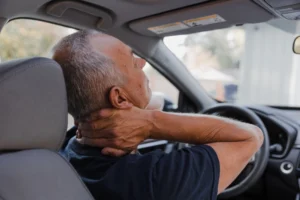
 “It was just a fender bender — I’m fine.” It’s one of the most common things we hear at Dohrmann Chiropractic’s car accident care program in Kansas City, usually from a patient who waited two or three weeks to come in after deciding their low-speed collision “wasn’t a big deal.” Then the stiffness set in. Then the headaches started. Then they couldn’t turn their head to check their blind spot without wincing. Minor-looking accidents cause real injuries far more often than most Kansas City drivers realize, and knowing when to get checked out can save you months of pain.
This is one of the most misunderstood parts of car accident recovery, so let’s walk through the actual physics of a low-speed collision, the injuries it commonly causes, and a simple way to decide whether you need to be seen.
Why a “Low Speed” Car Accident Doesn’t Mean “Low Impact”
A car accident doesn’t have to total your vehicle to injure your spine. Your neck and back are far more sensitive to sudden force than your bumper is. Insurance industry crash testing has repeatedly shown that occupants can experience real whiplash-type forces in collisions under 10 mph — speeds that often produce little more than a scuff or a cracked taillight on the vehicle itself.
Here’s why: modern bumpers are engineered to absorb impact and protect the car’s frame, not your spine. A stiff bumper system can transfer a surprising amount of force directly into the cabin during a low-speed hit, while your body — unrestrained except for a seatbelt — still whips forward and back in that split second. The vehicle damage and the injury risk to your body are two separate things, and Kansas City drivers who judge their injury risk by their repair estimate are often caught off guard days later.
Common Injuries We See After A “Minor” Kansas City Car Accident
Even parking-lot collisions, low-speed rear-end taps at a stoplight on N. Oak Trafficway, or minor side-impacts around Gladstone and Parkville can cause:
- Cervical strain and whiplash — even a modest jolt can hyperextend the neck
- Bulging discs or herniated discs — sudden compressive force on the spine can damage disc structures without any visible bruising
- Pinched nerves — misaligned vertebrae can put pressure on nearby nerve roots
- Sciatica — lower-back trauma from the impact can irritate the sciatic nerve, causing pain that radiates into the hip or leg
- Muscle and ligament sprains — soft tissue damage that doesn’t show up on a standard ER X-ray
None of these require a dramatic crash. They require sudden, unexpected force — and a 10-15 mph impact delivers exactly that.
A Quick Self-Assessment: Do You Need to Be Seen?
You don’t need to wait for severe pain to justify an evaluation. Ask yourself these questions after any collision, no matter how minor it looked:
- Did your head move suddenly, even slightly, on impact?
- Have you noticed any new stiffness, tightness, or reduced range of motion in your neck or back since the accident?
- Have you had a headache that started within a few days of the accident and won’t fully go away?
- Do you feel more fatigued than usual, or notice tension building through the day?
- Has anyone else in the vehicle reported symptoms, even mild ones?
If you answered yes to any of these, it’s worth getting a professional spinal evaluation — even if your car barely has a scratch. This is exactly the kind of case where an early exam prevents a small, manageable strain from becoming a chronic problem.
What an Evaluation at Dohrmann Chiropractic Actually Looks Like
A minor-accident evaluation isn’t complicated, and it isn’t going to turn a non-issue into a treatment plan you don’t need. Dr. Ben Dohrmann, Dr. Kevin McFadden, and Dr. Frank Siraguso each perform a hands-on assessment of your spine’s alignment, joint mobility, and muscle tone, checking for the subtle signs of soft-tissue and disc injury that a low-speed impact can cause. When indicated, on-site digital X-ray imaging lets us rule out structural issues the same day, without a separate referral or a wait for results.
If an issue is found, care is built around your specific injury — which may include targeted chiropractic adjustments to restore proper alignment, or SoftWave therapy to accelerate healing in strained soft tissue. If nothing significant turns up, you leave with peace of mind and a clean bill of health — which is valuable in itself, especially if a claim is involved.
Don’t Let a Small Repair Bill Talk You Out of Getting Checked
It’s natural to look at a minor dent and assume your body came through the same way your car did. But your spine doesn’t have a bumper. If you’ve been in any kind of collision recently in Kansas City, Gladstone, Parkville, Liberty, Smithville, or anywhere in Clay County or Platte County, it costs you very little time to get evaluated — and it can save you months of avoidable pain if something was missed.
Frequently Asked Questions
Can a minor car accident really cause a serious injury?
Yes. Injury risk depends on the sudden force applied to your body, not on how much damage your vehicle sustained. Whiplash, disc injuries, and nerve irritation can all occur in low-speed collisions, even when the car itself has little visible damage.
How fast does a collision need to be to cause whiplash?
Research and insurance crash testing have shown whiplash-type injuries can occur at speeds under 10 mph. The jolt to your neck happens in a fraction of a second, well before your body has time to brace for it.
I feel fine after my accident — should I still get checked?
It’s worth it, especially if you answered yes to any of the self-assessment questions above. Many soft-tissue and disc injuries don’t produce noticeable pain for 24 to 72 hours, since adrenaline and inflammation can temporarily mask symptoms.
Will a chiropractic evaluation after a minor accident be a waste of time if nothing is wrong?
No. A brief evaluation either confirms you’re clear or catches a problem early, when it’s far easier to treat. Either outcome is useful, and it takes far less time than dealing with a chronic issue months down the road.
What if the ER already cleared me after my accident?
Emergency rooms are focused on ruling out fractures, internal injuries, and life-threatening conditions. They aren’t designed to evaluate spinal alignment, joint restriction, or soft-tissue damage — the exact things a chiropractic exam is built to catch.
Does a low-speed accident still need to be documented for insurance purposes?
Yes. If any symptoms develop, having a documented evaluation close to the date of the accident helps establish that your injury is connected to the collision, which matters if you file a claim later.
How soon after a minor accident should I be evaluated?
As soon as reasonably possible, ideally within the first few days. Even if you feel fine at the moment, an early baseline exam makes it much easier to catch and treat any developing issue before it becomes chronic.
What conditions can result from an untreated minor accident injury?
Left unaddressed, minor accident injuries can progress into bulging discs, pinched nerves, chronic muscle tension, and reduced range of motion that becomes much harder to resolve the longer it’s left untreated.
Been in a car accident in Kansas City, even a minor one? Don’t wait to find out if you’re actually okay. Schedule an auto accident evaluation with Dohrmann Chiropractic today. Call or text us at (816) 436-5520, or visit us at 9576 N McGee St, Kansas City, MO 64155. We’re open Monday through Saturday and proudly serve Kansas City, Gladstone, Parkville, Liberty, Smithville, and all of Clay and Platte County.