
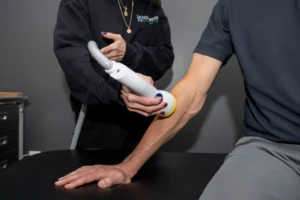
 For stubborn tendon and tissue pain, cortisone shots usually work faster, but shockwave therapy tends to give longer-lasting relief because it targets the healing problem instead of just calming inflammation. Neither one is “better” for every condition, so the right choice depends on what’s hurting and how long it has been going on. At Dohrmann Chiropractic in Kansas City, we use SoftWave shockwave therapy for patients who’ve had pain that keeps coming back, and we’re upfront about when a different option makes more sense.
What Is the Difference in Shockwave Therapy vs Cortisone Shots?
A cortisone shot injects a steroid medication to reduce inflammation and swelling in the painful area. Shockwave therapy uses acoustic waves applied through the skin to stimulate circulation and tissue repair in chronic problem areas. One is a drug that dials down inflammation. The other is a signal that encourages the body to rebuild.
That distinction explains most of the differences in results when comparing shockwave therapy vs cortisone shots. Many long-standing tendon and fascia problems, such as plantar fasciitis, tennis elbow, and Achilles pain, involve damaged, poorly healing tissue more than active inflammation. A treatment that only suppresses inflammation can bring relief for a while without addressing why the area hurts.
Which Works Faster: Shockwave Therapy vs Cortisone Shots?
Cortisone shots generally win on speed. Many people feel meaningful relief within days, which is why injections are popular when pain is severe or an event is coming up. Shockwave therapy is a series treatment, and improvement usually builds across several sessions instead of arriving overnight.
Speed isn’t the whole picture, though. What matters to most people is whether the relief lasts, and that’s where the research gets interesting.
Which Lasts Longer: Shockwave Therapy vs Cortisone Shots?
In most studies, shockwave therapy vs cortisone shots favors shockwave over the long run. A 2010 review in The Lancet pooled 41 randomized trials covering 2,672 patients with tennis elbow and other tendon problems. It found corticosteroid injections reduced pain in the short term, but the benefit faded and did not persist at intermediate or longer follow-up, according to the published review.
For plantar fasciitis, a 2024 systematic review and meta-analysis in Clinical Rehabilitation compared the two directly. It reported that shockwave therapy was more effective than corticosteroid injections for pain and foot function at both three and six months, as described in the study listing. Research varies by condition and by how each treatment is delivered, so these findings are a guide, not a guarantee for any one person.
What Are the Risks of Cortisone Shots?
Cortisone shots are widely used and often appropriate, but they carry real trade-offs. Possible downsides include a temporary flare of pain after the injection, thinning or lightening of the skin, weakening of nearby tendon or fascia tissue, and temporary spikes in blood sugar for people with diabetes. Because repeated steroid exposure can weaken tissue, doctors typically limit how many injections you should have in the same area.
In the shockwave therapy vs cortisone shots debate, cortisone still has a place. For a severely inflamed joint or bursa, or when pain is intense and short-term relief is the priority, an injection may be the right call. Your medical doctor is the right person to help weigh that.
What Are the Risks of Shockwave Therapy?
Shockwave therapy is non-invasive, with no needles and no downtime, and side effects are usually mild. The most commonly reported are temporary soreness, redness, or tenderness in the treated area. Because it’s a treatment, not a procedure, you can typically return to normal daily activity right after a session.
It isn’t right for everyone. Before treatment, we review your history and screen for situations that call for caution or a different plan, such as pregnancy, active infection, a bleeding disorder or blood-thinning medication, certain implanted devices, or a suspected tumor in the treatment area. If shockwave isn’t a safe fit, we’ll tell you.
Which Conditions Respond Best to Shockwave Therapy?
Shockwave therapy is most often used for chronic tendon and soft-tissue problems that haven’t responded to rest, stretching, or other care. Common examples include plantar fasciitis and heel pain, tennis and golfer’s elbow, Achilles tendon pain, shoulder tendon pain, and persistent muscle tightness. Patients whose pain has lasted weeks or months, or who have already tried an injection with only temporary relief, are often the best candidates.
It isn’t a fix for everything. Pain that starts in the spine, such as a pinched nerve or sciatica from a disc problem, may need a different focus, so we examine the whole picture first.
Can You Combine Shockwave Therapy and Cortisone Shots?
Some patients try an injection first and then move to shockwave when relief fades. If you’ve recently had a cortisone shot, or are considering one, let us know and talk with your prescribing doctor about timing before starting any other treatment in the same area. We’ll coordinate with your medical team when it helps.
How Do We Decide Between Shockwave Therapy vs Cortisone Shots for You?
We start with your history, a hands-on exam, and, when it helps, on-site digital X-rays. Dr. Ben Dohrmann, Dr. Kevin McFadden, and Dr. Frank Siraguso look for where your pain is truly coming from, since treating the wrong area wastes time. When shockwave fits, it’s often paired with chiropractic care, movement guidance, and exercises that help the improvement last.
Why Kansas City Patients Choose Us for Shockwave Therapy
Dohrmann Chiropractic has helped patients from Kansas City, Gladstone, Parkville, Liberty, Smithville, Clay County, and Platte County since 2008, backed by more than 600 five-star Google reviews and 46+ years of combined clinical experience. Dr. Dohrmann, a former Olympic Team Chiropractor at the London 2012 Summer Olympics, and his team give you a clear plan, an honest opinion, and no pressure.
Weighing shockwave therapy vs cortisone shots for your pain? Schedule online, call or text us at (816) 436-5520, or visit us at 9576 N McGee St, Kansas City, MO 64155.
Frequently Asked Questions
Is shockwave therapy better than cortisone shots?
For chronic tendon and fascia pain, research often favors shockwave therapy for longer-lasting relief, while cortisone works faster in the short term. The best choice depends on your condition.
Which works faster, shockwave therapy or cortisone?
Cortisone usually works faster, often within days. Shockwave therapy is a series treatment, so improvement builds over several sessions.
Does cortisone fix the cause of tendon pain?
Not usually. Cortisone reduces inflammation, but many chronic tendon problems involve poorly healing tissue, which is why relief can fade.
Is shockwave therapy painful?
Most people feel a tapping or pulsing sensation that can be tender over sore spots. It’s generally well tolerated, and temporary soreness afterward is the most common side effect.
What does shockwave therapy treat?
Common uses include plantar fasciitis, heel pain, tennis and golfer’s elbow, Achilles tendon pain, shoulder tendon pain, and other chronic soft-tissue problems.
Can I get shockwave therapy after a cortisone shot?
Many people do, but timing matters. Tell us about any recent injection and check with your prescribing doctor before starting treatment in the same area.
Who should not get shockwave therapy?
Caution applies with pregnancy, infection, bleeding disorders or blood thinners, certain implanted devices, or a suspected tumor in the treatment area. We screen every patient first.
Does Dohrmann Chiropractic treat patients outside Kansas City?
Yes. We regularly treat patients from Gladstone, Parkville, Liberty, Smithville, and throughout Clay County and Platte County, in addition to Kansas City itself.