
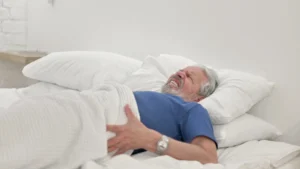
 The best sleeping position for a herniated disc is usually on your side with a pillow between your knees, or on your back with a pillow under your knees. Both keep your spine in a neutral position and take pressure off the injured disc and the nerve it’s irritating. At Dohrmann Chiropractic in Kansas City, sleep is one of the first things we address in every disc bulge and herniation treatment plan, because the hours you spend in bed can either support your recovery or quietly undo the progress you made during the day.
Which Is the Best Sleeping Position for a Herniated Disc: Side or Back?
Both work for most people, and neither is universally better. The best sleeping position for a herniated disc is the one that keeps your spine neutral and your leg symptoms quietest. Side-lying with a pillow between your knees and back-lying with a pillow under your knees are the two positions most often recommended for a herniated disc, and many patients rotate between them during the night.
A few patients feel better slightly reclined, because bending forward a little eases their pressure. If standing up straight aggravates your symptoms but leaning forward gives relief, a wedge pillow or an adjustable bed with a pillow under your knees may be worth trying. Your symptoms are the best guide, so use whichever position lets you fall asleep and stay asleep with the least leg pain.
How Do You Sleep on Your Side With a Herniated Disc?
Lie on your side with your knees slightly bent and a firm pillow between your knees and thighs, thick enough that your top knee stays level with your hip. Without that pillow, your top leg drops forward, your pelvis rotates, and your lower back twists for hours. A pillow under your head that fills the gap between your ear and shoulder keeps your neck in line with the rest of your spine.
Keep your knees loosely bent rather than pulled tightly toward your chest, since a deep curl rounds your lower back and loads the back of the disc. A body pillow also helps, because it supports your top leg and keeps you from rolling onto your stomach in your sleep. If your disc problem causes sciatica, try both sides and favor the one that eases your leg pain. For many people with leg symptoms, this is the best sleeping position for a herniated disc.
Can You Sleep on Your Back With a Herniated Disc?
Yes, and for many people it’s the best sleeping position for a herniated disc in the lower back. Lying on your back with one or two pillows under your knees relaxes the muscles that pull on your lower back and supports the natural curve of your spine. Add a thin, supportive pillow under your head and, if you like, a small rolled towel under the curve of your lower back.
Lying down takes far more load off your discs than sitting or standing, so any supported position beats an unsupported one. If you wake up stiff after a night flat on your back, that’s a sign to adjust the pillow height under your knees or switch to your side for part of the night.
Is Sleeping on Your Stomach Bad for a Herniated Disc?
For most people, yes. Stomach sleeping is the position spine professionals most often tell disc patients to avoid, because it arches your lower back and forces your neck to stay rotated for hours. That combination can aggravate both a lumbar disc and a neck disc.
If you can’t break the habit, place a thin pillow under your hips and lower abdomen to reduce the arch, and use a very flat pillow or none under your head. A small number of patients with a disc problem feel better in positions that gently arch the back, which is why the best sleeping position for a herniated disc isn’t identical for everyone. We test which direction of movement calms your symptoms during your exam instead of guessing.
What Mattress and Pillow Work Best for a Bulging or Herniated Disc?
Your bed setup determines how well the best sleeping position for a herniated disc actually works. A medium-firm mattress is the most commonly recommended choice for people with a bulging disc or herniated disc, because a very soft surface lets your spine sag while a very firm one doesn’t conform to your hips and shoulders. A randomized trial of 313 adults with chronic low back pain, published in The Lancet, found that medium-firm mattresses produced more improvement in pain and disability than firm ones over 90 days. That study looked at chronic low back pain in general rather than herniated discs specifically, so treat it as a useful guide and not a guarantee.
Your pillow matters too. Whether you sleep on your back or side, your head should sit in line with your spine, not tipped up or down. This is especially important if you have a disc problem in your neck, since a cervical herniation often shows up as tingling in the arm or hand, and a poorly chosen pillow can keep that nerve irritated all night.
How Do You Get In and Out of Bed Without Aggravating a Disc Problem?
Use the log roll. To get up, bend your knees, roll onto your side as one unit so your shoulders and hips move together, then swing your legs over the edge of the bed while you push yourself upright with your arms. To lie down, reverse the steps. Sitting straight up from lying on your back, like a crunch, bends your lower back forward under load, and that is the motion a herniated disc dislikes most.
Why Does Disc Pain Feel Worse at Night or First Thing in the Morning?
Lying in bed doesn’t make a disc worse, but it does remove the distractions that hide pain during the day. Your discs also absorb fluid while you’re lying down, which can leave your spine stiffer and more sensitive during the first stretch after you wake up. Staying in one position for hours can also leave an irritated nerve more reactive, which is why a pinched nerve from a disc often flares in the early morning.
Gentle movement usually eases that stiffness, and the best sleeping position for a herniated disc helps keep it from building up overnight. If your pain is waking you every night, getting steadily worse, or no longer responds to position changes, that’s a reason to have your spine evaluated instead of waiting it out.
Which Nighttime Symptoms Mean You Need Emergency Care?
Loss of bladder or bowel control, numbness in the groin or inner thighs, or rapidly worsening weakness in both legs are emergency symptoms that require immediate medical attention, not a scheduled appointment. These can signal a rare condition called cauda equina syndrome, where a large disc herniation compresses multiple nerve roots at once. If you notice any of them, go to an emergency room right away.
Increasing weakness in one leg, a foot that catches or drags when you walk, or numbness that keeps spreading should also be evaluated promptly.
How Does Chiropractic Care Help You Sleep Better With a Disc Problem?
The right pillow setup makes nights more comfortable, but it doesn’t fix the disc itself. Lasting relief comes from treating the cause. Dr. Ben Dohrmann, Dr. Kevin McFadden, and Dr. Frank Siraguso start with a thorough exam and, when needed, on-site digital X-rays, then build a plan that can include chiropractic adjustments above and below the injured level, therapeutic exercises, and non-surgical spinal decompression on the DRX9000 to reduce pressure inside the disc.
Dr. Dohrmann was diagnosed with degenerative disc disease at age 23 and found relief through chiropractic care himself, so he understands what chronic back pain does to your days and your sleep. As pressure on the nerve comes down, most patients find their nights get easier too.
Why Kansas City Patients Trust Us With Disc Pain That Disrupts Sleep
Our team has helped patients throughout Kansas City, Gladstone, Parkville, Liberty, Smithville, Clay County, and Platte County with disc problems since 2008, backed by more than 600 five-star Google reviews and 46+ years of combined clinical experience. We’ll show you the best sleeping position for a herniated disc in your specific case and treat the problem behind it, with no drugs or surgery as the first step.
Ready for a better night’s sleep? Schedule online, call or text us at (816) 436-5520, or visit us at 9576 N McGee St, Kansas City, MO 64155.
Frequently Asked Questions
What is the best sleeping position for a herniated disc?
For most people, it’s either on your side with a pillow between your knees or on your back with a pillow under your knees. Both keep your spine neutral and reduce pressure on the injured disc.
Is it better to sleep on your back or side with a herniated disc?
Neither is universally better. Choose the position that keeps your spine supported and your leg symptoms calmest, and feel free to alternate between them during the night.
Should the pillow go under or between my knees?
Under your knees if you sleep on your back, and between your knees if you sleep on your side. Each placement keeps your lower back and pelvis from being pulled out of alignment.
Is sleeping on your stomach bad for a herniated disc?
Usually, yes. It arches your lower back and keeps your neck rotated for hours. If you can’t avoid it, place a thin pillow under your hips and use a very flat head pillow.
What mattress is best for a bulging or herniated disc?
A medium-firm mattress is most often recommended. It supports your spine without letting it sag, and research on chronic low back pain has favored medium-firm over firm surfaces.
Why does my herniated disc hurt more at night?
Fewer daytime distractions, long periods in one position, and fluid your discs absorb overnight can all make pain and stiffness more noticeable at night and first thing in the morning.
How do I get out of bed with a herniated disc?
Bend your knees, roll onto your side as one unit, then swing your legs off the bed while pushing yourself up with your arms. Avoid sitting straight up from lying on your back.
Does Dohrmann Chiropractic treat patients outside Kansas City?
Yes. We regularly treat patients from Gladstone, Parkville, Liberty, Smithville, and throughout Clay County and Platte County, in addition to Kansas City itself.