
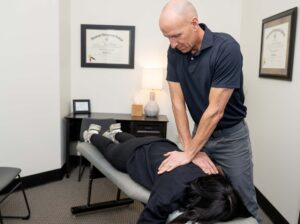
 Getting a chiropractic adjustment does not hurt for the vast majority of patients — most people feel pressure, a release of tension, and often immediate relief rather than pain, and any brief soreness afterward is usually mild and short-lived, similar to how you’d feel after a light workout. At Dohrmann Chiropractic in Kansas City, this is the single most common fear we hear from first-time patients, and it’s almost always based on assumptions rather than what an adjustment actually feels like.
What Does a Chiropractic Adjustment Actually Feel Like?
Most patients describe a chiropractic adjustment as a quick sensation of pressure followed by a release, often accompanied by an audible pop or crack, and then a noticeable feeling of looser, freer movement in the treated area. The adjustment itself typically takes only a second or two per area. There’s no cutting, no needles, and no prolonged discomfort — just a controlled, precise movement applied to a specific joint.
Many patients are surprised that the moment they were anxious about turns out to be the most satisfying part of the visit, comparing it to finally cracking a stiff knuckle that’s been bothering them all day.
Why Do Some People Feel Sore After an Adjustment?
A small number of patients feel mild soreness in the 24 to 48 hours after their first few adjustments, similar to the muscle soreness you’d feel after starting a new exercise routine, because muscles and joints that have been restricted are moving through a fuller range of motion than they’re used to. This soreness is typically mild, temporary, and a normal part of your body adjusting to improved movement — it’s not a sign that anything went wrong.
This tends to happen most with patients who’ve had restricted movement for a long time before their first visit. As your body gets used to regular adjustments, this initial soreness typically fades and often disappears entirely.
Does the Popping Sound Mean It’s Working (or Hurting You)?
The popping or cracking sound during an adjustment is simply gas bubbles releasing from the fluid inside your joints — a normal, harmless process called cavitation — and it doesn’t indicate pain or injury either way. You don’t need to hear a pop for an adjustment to be effective, and hearing one doesn’t mean anything went wrong. It’s simply a byproduct of the joint moving through its normal range of motion.
Patients often fixate on this sound before their first visit, imagining something forceful or dangerous. In reality, it’s the same harmless sound as cracking your knuckles, just applied with precision to a specific spinal joint by a trained doctor.
Is It Normal to Feel Nervous Before Your First Adjustment?
Yes, feeling nervous before your first chiropractic adjustment is extremely common, and most of that anxiety comes from not knowing what to expect rather than any real physical discomfort involved. Dr. Ben Dohrmann, Dr. Kevin McFadden, and Dr. Frank Siraguso walk every new patient through exactly what will happen before any adjustment takes place, so there are no surprises.
We also welcome questions at any point during your visit. If you’re nervous about a specific area, tell us, and we’ll explain exactly what to expect there before we proceed.
Can an Adjustment Ever Actually Hurt?
A properly performed chiropractic adjustment shouldn’t cause sharp or significant pain, and if something feels genuinely painful during treatment, that’s important feedback your chiropractor needs immediately, not something to push through. This is exactly why a thorough exam — and, when needed, digital X-ray imaging — happens before any adjustment, to make sure the technique and force used are appropriate for your specific spine and condition.
Techniques are also adjusted based on your comfort level, your condition, and your body type. A gentle, low-force technique used on an older patient or someone in acute pain looks and feels very different from the technique used on a healthy, active athlete.
How Do Chiropractors Adjust Their Technique for Sensitive Patients?
Chiropractors have multiple adjustment techniques available and select the appropriate one based on your age, condition, and comfort level — from traditional hands-on adjustments to gentler, instrument-assisted methods that use light, controlled force instead of manual thrust. Patients recovering from an auto accident, pregnant patients, and older adults with more fragile joints often benefit from these gentler approaches, which are just as effective without the more forceful sensation some people worry about.
Does It Hurt More If You’re Already in Pain from an Injury?
When you’re already in significant pain from an acute injury, your first few visits typically focus on reducing inflammation and easing you into treatment gradually, rather than jumping straight into a full-force adjustment. We modify our approach specifically for patients who come in already hurting, using gentler techniques and additional therapies until your body is ready for more direct treatment.
Why Kansas City Patients Say the Fear Is Worse Than the Reality
Time and again, our new patients throughout Kansas City, Gladstone, Parkville, Liberty, Smithville, Clay County, and Platte County tell us the same thing after their first visit — the anticipation was far worse than the actual adjustment. We take the time to explain every step, answer every question, and adjust our approach to your comfort level, because a nervous, tense patient is harder to treat effectively than a relaxed one.
Ready to see for yourself? Schedule online, call or text us at (816) 436-5520, or visit us at 9576 N McGee St, Kansas City, MO 64155.
Frequently Asked Questions
Does getting a chiropractic adjustment hurt?
No, not for most patients. Most people feel pressure and release rather than pain, often followed by immediate relief. Any mild soreness afterward is typically brief.
Why do I feel sore after my first adjustment?
Mild soreness in the first 24 to 48 hours is common as muscles and joints move through a fuller range of motion than they’re used to, similar to soreness after starting a new exercise routine.
What does the popping sound during an adjustment mean?
It’s gas bubbles releasing from fluid inside your joints, a harmless process called cavitation. It doesn’t indicate pain or injury, and you don’t need to hear it for the adjustment to work.
Is it normal to be nervous before a chiropractic adjustment?
Yes, this is very common, especially for first-time patients. Most of the anxiety comes from not knowing what to expect rather than any actual discomfort.
Can a chiropractic adjustment ever actually hurt?
A properly performed adjustment shouldn’t cause sharp pain. If something feels painful, that’s important feedback for your chiropractor, and techniques are adjusted based on your comfort and condition.
Are there gentler chiropractic techniques for sensitive patients?
Yes. Instrument-assisted and other low-force techniques are available for patients who are pregnant, recovering from injury, or have more fragile joints, and are just as effective as traditional adjustments.
Does it hurt more if I’m already in pain from an injury?
Not typically. Treatment for patients already in significant pain usually starts gently, focusing on reducing inflammation before progressing to more direct adjustments.
Does Dohrmann Chiropractic treat patients outside Kansas City?
Yes. We regularly treat patients from Gladstone, Parkville, Liberty, Smithville, and throughout Clay County and Platte County, in addition to Kansas City itself.