
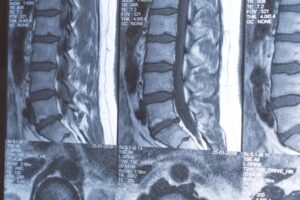
 Disc bulge and herniation treatment in Kansas City begins the moment you realize the shooting pain down your leg isn’t going away on its own. You bent over to pick up a box. Or you’ve been sitting at your desk for years with terrible posture. Or you twisted wrong getting out of bed. Maybe it happened during a car accident on I-435 last week. Now your back is on fire and your leg feels like it’s being electrocuted.
At Dohrmann Chiropractic in Kansas City, we treat disc problems every single day. People come in from Gladstone, Parkville, Liberty, and all over the metro area because they’re scared. They googled their symptoms and everything says surgery. They’re worried they’ll never feel normal again.
Here’s what’s actually happening in your spine. The discs between your vertebrae are like jelly donuts. They have a tough outer layer and a gel-like center. When you put too much pressure on a disc—from years of bad posture, from lifting wrong, from an accident—the gel can push against the outer layer (bulge) or break through it completely (herniation).
When that disc material pushes out, it presses on the nerves running down your spine. Those nerves control sensation and movement in your legs. Pressure on the nerve creates the shooting pain, numbness, tingling, or weakness you’re experiencing. The pain might run all the way down to your foot. You might not be able to stand up straight. Sitting might be unbearable.
Most disc bulges and herniations don’t require surgery. They respond to conservative treatment. Dr. Ben Dohrmann, Dr. Kevin McFadden, and Dr. Frank Siraguso have successfully treated hundreds of patients with disc problems who were told surgery was their only option. You have choices.
Why Is Chiropractic Care Important for Disc Problems?
Chiropractic care is important for disc problems because it addresses the mechanical dysfunction causing pressure on the disc, reduces inflammation around the injured area, and helps your body heal naturally without surgery or long-term medication use. Surgery should be the last resort, not the first option.
When a disc bulges or herniates, your spine compensates. The vertebrae around the injured disc lock up trying to protect it. Your muscles go into spasm. Your posture shifts to avoid pain. All of this creates a cycle that prevents healing.
Chiropractic adjustments restore normal movement to restricted segments of your spine. When we adjust the areas above and below the injured disc, it takes pressure off the damaged tissue. This creates space for the disc material to move back toward its normal position.
We also reduce inflammation. Inflammation is your body’s healing response, but too much inflammation presses on nerves and causes pain. Through adjustments, soft tissue therapy, and other treatments, we calm down the inflammatory response so healing can happen faster.
Most importantly, chiropractic care is conservative. We’re not cutting into your spine or prescribing opioids. We’re working with your body’s natural healing ability. Research shows that the majority of disc herniations improve with conservative care within 6-12 weeks.
What Are the Symptoms of a Bulging or Herniated Disc?
Symptoms of a bulging or herniated disc include sharp pain in your lower back, shooting pain down one or both legs (sciatica), numbness or tingling in your legs or feet, muscle weakness, and pain that worsens when sitting, bending forward, or coughing. Not everyone has all these symptoms, and severity varies.
Lower back pain is usually the first sign. It might start as a dull ache that gradually gets worse. Or it might come on suddenly after lifting something heavy. The pain often stays in one spot in your lower back, right where the disc is injured.
Leg pain is the hallmark of a disc herniation pressing on a nerve. This isn’t vague discomfort. It’s sharp, burning, or electric pain that follows a specific path down your leg. If the herniation is at L4-L5, the pain runs down the outside of your leg. If it’s at L5-S1, it goes down the back of your leg and into your foot.
Numbness and tingling happen when the nerve is compressed but not completely blocked. You might feel pins and needles in your calf or foot. Your toes might feel numb. Some people describe it as their leg “falling asleep” but it never wakes back up.
Weakness is more serious. If you can’t stand on your toes or lift your foot up (foot drop), the nerve is significantly compressed. This requires immediate attention. The longer a nerve stays compressed, the more likely you’ll have permanent damage.
Pain when sitting is classic for disc problems. Sitting increases pressure inside the disc by 40% compared to standing. If your pain is much worse sitting at your desk or driving, that’s a strong indicator you have a disc issue.
Will My Insurance Cover Disc Bulge and Herniation Treatment?
Your health insurance will typically cover chiropractic treatment for disc bulges and herniations because these are medically necessary conditions, and most plans recognize chiropractic care as appropriate conservative treatment before considering surgery. We accept most major insurance carriers and will verify your benefits before you start treatment.
Coverage varies by plan. Some policies cover 20-30 visits per year. Others cover more. Most require a copay per visit, which usually ranges from $20-$50. We’ll tell you exactly what your plan covers when you call.
If your disc problem resulted from a car accident, your auto insurance covers treatment through your Personal Injury Protection (PIP) or Medical Payments coverage. This is separate from your health insurance and often has higher limits specifically for accident-related injuries.
Workers’ compensation covers disc injuries that happened on the job. If you hurt your back lifting at work or sitting at your desk for years caused your disc to herniate, you should file a workers’ comp claim. Treatment is covered at 100% with no out-of-pocket cost to you.
For personal injury cases where someone else caused your disc injury, we can work on a lien basis. This means we provide treatment now and get paid when your case settles. We coordinate with your attorney to ensure everything is documented properly for your claim.
Bring your insurance card to your first visit. We’ll contact your insurance company, verify your coverage, and explain your financial responsibility before we start treatment. No surprises.
What Does Treatment for a Disc Bulge or Herniation Look Like?
Treatment for a disc bulge or herniation at Dohrmann Chiropractic includes spinal adjustments to restore proper movement, spinal decompression therapy to create negative pressure that pulls the disc back into place, therapeutic exercises to strengthen supporting muscles, and lifestyle modifications to prevent re-injury. Most patients need 2-3 visits per week for the first few weeks.
We start with a thorough examination. We need to know exactly which disc is herniated and how badly. If you don’t have recent MRI results, we might order one. MRI is the gold standard for seeing disc problems. X-rays show bones but not soft tissue like discs.
Spinal decompression is often the cornerstone of treatment for disc herniations. We have a DRX9000 spinal decompression table in our office. You lie on the table and it gently stretches your spine in a very specific way. This creates negative pressure inside the disc, which can pull the herniated material back toward the center where it belongs.
Adjustments restore mobility to restricted segments of your spine. We don’t adjust the herniated segment directly in the acute phase—that could make things worse. Instead, we adjust above and below the injury to take pressure off the damaged disc.
Soft tissue therapy addresses the muscle spasms that develop around a disc injury. Tight muscles compress the spine and prevent healing. We use various techniques to relax these muscles and improve circulation to the injured area.
Exercises are critical for long-term success. We teach you specific stretches and strengthening exercises that support your spine. Core stability work prevents future disc problems by taking stress off your discs during daily activities.
Treatment frequency depends on severity. Acute herniations with severe pain might require daily visits for the first week. As you improve, we space appointments to 2-3 times per week, then once a week, then maintenance care as needed.
How Long Does It Take to Heal From a Disc Bulge or Herniation?
Healing from a disc bulge or herniation typically takes 6-12 weeks with consistent treatment, though some patients feel significantly better within 2-3 weeks and others with severe herniations may need several months of care. Age, overall health, the size of the herniation, and how well you follow your treatment plan all affect recovery time.
The first 1-2 weeks focus on pain reduction. You’re probably in significant pain when you first come in. We need to calm down the inflammation and give you relief so you can function. Many people notice improvement within the first few treatments, though you’re not healed yet.
Weeks 3-6 involve corrective care. The pain is better but the disc hasn’t fully healed. This is when we really work on restoring normal spinal mechanics and pulling the disc material back into position through decompression. Patients sometimes get frustrated during this phase because they feel better and don’t understand why they still need treatment.
Here’s why you can’t stop too soon. Disc tissue heals slowly because it has poor blood supply. Just because the pain is gone doesn’t mean the disc is healed. If you stop treatment prematurely, the herniation can worsen or you can re-injure it doing something simple like bending over to tie your shoe.
Weeks 7-12 focus on stabilization and strengthening. We continue treatment but reduce frequency. You’re doing more exercises at home. The goal is to make sure the healing is solid and you’re strong enough that normal activities won’t cause a setback.
Some factors slow healing. Smoking reduces blood flow to tissues and delays healing. Obesity puts extra pressure on your discs. A sedentary lifestyle with lots of sitting prevents recovery. We address all of these factors as part of your treatment plan.
People who do their exercises, follow our recommendations about activity modification, and come in for all their scheduled appointments heal faster. Those who skip appointments or ignore advice about lifting and posture take longer to recover and are more likely to re-injure themselves.
Can Chiropractic Help Me Avoid Surgery for My Disc?
Chiropractic care can help you avoid surgery for your disc in many cases because research shows that conservative treatment successfully resolves 60-80% of disc herniations without surgical intervention, and surgery should only be considered after 6-12 weeks of appropriate conservative care has failed. We’ve helped hundreds of patients avoid operations they thought were inevitable.
Here’s what most people don’t know. The natural history of disc herniations favors reabsorption. Your body recognizes the herniated disc material as foreign tissue and gradually breaks it down and absorbs it. This process takes months, but it happens naturally in most cases.
Surgery removes the herniated portion of the disc. Sometimes this is necessary. But it comes with risks—infection, failed back surgery syndrome, damage to surrounding structures, and the fact that you can never get that disc tissue back. Once it’s cut out, your spine is permanently altered.
The medical literature shows that patients who have surgery initially feel better faster than those who do conservative treatment. But at the one-year mark, outcomes are the same. People who avoided surgery feel just as good as people who had it, but they still have their original disc intact.
That said, some situations require surgery. If you have cauda equina syndrome (loss of bowel or bladder control), that’s a surgical emergency. If you have progressive weakness or foot drop that’s getting worse despite treatment, surgery might be necessary to prevent permanent nerve damage.
We’re not anti-surgery. We’re pro-patient. If surgery is truly needed, we’ll tell you and refer you to an excellent neurosurgeon or orthopedic spine specialist. But surgery should be the last option, not the first one presented.
Insurance companies know this too. Most require documentation of 6-12 weeks of conservative care before they’ll approve spine surgery. They want to see that non-surgical options were tried first.
What Should I Avoid Doing With a Disc Herniation?
You should avoid bending forward at the waist, sitting for long periods, lifting anything heavy, twisting your spine, high-impact activities like running or jumping, and any movement that reproduces your leg pain. These activities increase pressure on the disc and can make the herniation worse.
Bending forward is the worst thing you can do with a disc herniation. When you bend forward, the disc compresses on the front and bulges out the back—exactly where most herniations occur. Don’t bend forward to pick things up, tie your shoes, or empty the dishwasher. Squat down or get on one knee instead.
Sitting increases disc pressure significantly. If you work at a desk, this is a problem. Get up every 20-30 minutes and walk around. Use a lumbar support roll to maintain the curve in your lower back. Consider a standing desk if possible. Some of our patients do much better working from a recliner with their laptop than sitting upright in a chair.
Lifting heavy objects is obvious, but people don’t realize how little weight it takes to aggravate a herniated disc. Even lifting a laundry basket or a bag of groceries can cause a setback. If you have to lift something, keep it close to your body, bend at your knees, and avoid twisting.
Twisting combines the worst movements for your spine. Don’t twist while lifting. Don’t twist to reach something behind you. Don’t do exercises that involve twisting like Russian twists or golf swings until your disc has healed.
High-impact exercise pounds your spine with each step. Running, jumping, and aerobics classes are out until you’re significantly better. Walking is usually okay if it doesn’t increase your pain. Swimming is excellent because the water supports your body weight.
We give you specific activity guidelines based on your individual case. Some people need to modify activities for a few weeks. Others need to be very careful for several months. It depends on the severity of your herniation.
What Happens at My First Appointment?
At your first appointment, we’ll take a detailed history of your symptoms, perform orthopedic and neurological tests to identify which disc is herniated and which nerves are affected, take X-rays to evaluate your spinal alignment, and develop a specific treatment plan. The entire visit takes about 45 minutes to an hour, and most people start treatment the same day.
We need to understand your pain pattern. When did it start? What were you doing when it started? Is it constant or does it come and go? What makes it better or worse? Does the pain stay in your back or does it shoot down your leg? These details tell us a lot about what’s happening.
Then we examine you. We watch how you move. We test your range of motion. We perform specific orthopedic tests that provoke symptoms to confirm which disc is involved. We test your reflexes, muscle strength, and sensation to determine which nerves are compressed.
X-rays help us see your spinal alignment and look for any degenerative changes. We have digital X-ray equipment right here in our office on North McGee Street. We can take and review the images immediately.
If you already have an MRI from your doctor, bring it with you. If you don’t have one and we think it’s necessary based on your examination, we’ll order one. MRI shows the soft tissue—the discs, nerves, and ligaments—that X-rays can’t see.
Once we know what’s wrong, we explain it to you in plain English. We show you on the images. We tell you how bad it is and what treatment will look like. We discuss how long recovery typically takes and what you need to do at home to help the healing process.
Most people start treatment during the first visit. There’s no reason to wait if you’re already here and we’ve identified the problem. We’ll do the first spinal decompression session, adjust areas that need it, and teach you initial exercises or stretches.
Do You Treat Disc Problems in the Neck Too?
We treat disc problems in the neck (cervical disc herniations) using the same conservative approach as lumbar disc herniations, though neck disc problems create different symptoms like arm pain, hand numbness, and headaches instead of leg symptoms. Neck disc herniations often result from car accidents, poor posture from computer work, or degenerative changes over time.
Cervical disc symptoms typically involve arm pain rather than leg pain. You might have pain that shoots down your shoulder, into your elbow, or all the way to your fingers. The specific pattern of pain tells us which cervical disc is herniated.
Numbness and tingling in your hands is common. You might have trouble with fine motor tasks like buttoning a shirt or typing. Some people drop things because their grip strength is affected.
Headaches are a frequent symptom of upper cervical disc problems. These headaches usually start at the base of your skull and radiate forward. They’re often worse in the morning after sleeping in a poor position.
Treatment for cervical discs includes gentle adjustments to the neck and upper back, cervical decompression therapy, soft tissue work on the muscles of your neck and shoulders, and specific exercises to improve neck posture and strength.
We’re especially careful with neck adjustments when a disc herniation is involved. We use very gentle techniques and avoid forceful rotation. The goal is to restore motion without aggravating the herniation.
People with desk jobs or who spend hours looking down at phones often develop cervical disc problems. Forward head posture puts enormous stress on the discs in your neck. For every inch your head moves forward from neutral position, it adds 10 pounds of pressure on your cervical spine. No wonder these discs give out.
Ready to Get Treatment for Your Disc Problem?
If you’re dealing with a bulging or herniated disc, you don’t have to accept surgery as your only option or keep suffering while waiting to see if it gets better on its own. Conservative chiropractic treatment successfully resolves most disc problems without surgery, and starting treatment early dramatically improves your chances of complete recovery.
We’ve been helping Kansas City residents with disc problems since 2008. People come to us from Gladstone, Parkville, Liberty, Smithville, and all over the metro area because they want to avoid surgery if possible. Our three doctors work together to provide comprehensive care that addresses your specific disc condition.
Call our office at 816-436-5520 to schedule your evaluation. We can usually see you within 24-48 hours. Don’t wait until Monday if you’re in pain over the weekend—we have Saturday appointments available.
Bring any MRI or X-ray results you already have and your insurance card. We’ll verify your coverage and let you know your out-of-pocket cost before starting treatment. If you don’t have imaging yet, we’ll take X-rays in our office and can order an MRI if needed.
The longer you wait with a disc herniation, the harder it becomes to treat. Discs can heal, but they need the right environment and treatment approach. What starts as a minor bulge can progress to a severe herniation if you ignore it and keep doing activities that aggravate it.
Most people who come in early—within the first few weeks of symptoms—do very well with conservative care. Those who wait months or years often have more complicated cases that take longer to resolve.
You deserve to know all your options before committing to surgery. Even if you’ve already seen a surgeon who recommended an operation, get a second opinion from a conservative care perspective. Surgery is permanent. You can always have it done later if conservative care doesn’t work. But you can’t undo it once it’s done.
Our practice has served Kansas City families for over 15 years. With 745 Google reviews and a 4.9-star rating, people trust us to provide honest, effective care. We’ll tell you exactly what we find and whether we think we can help you.
Dohrmann Chiropractic
9576 North McGee Street
Kansas City, MO 64155
(816) 436-5520
Office Hours:
Monday-Friday: 9am-12pm, 2:30pm-5:30pm
Saturday: 9am-12pm