
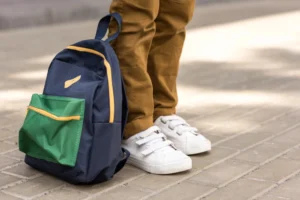
 Your child’s backpack should weigh no more than 10 to 15 percent of their body weight — so a 60-pound child shouldn’t be carrying more than about 6 to 9 pounds to school. At Dohrmann Chiropractic in Kansas City, we see the effects of overloaded backpacks every fall once school starts back up — kids complaining of shoulder pain, headaches, and slouched posture that traces right back to what they’re hauling to and from school every day. Here’s exactly how heavy your child’s backpack should be, what happens when it’s not, and what to do about it.
What Is the 10% Rule for Backpack Weight?
The 10% rule is the general guideline pediatric health experts use to answer how heavy your child’s backpack should be: keep the loaded backpack at or under 10 to 15 percent of your child’s total body weight. For a 50-pound second grader, that’s a hard ceiling of about 5 to 7.5 pounds. For a 100-pound middle schooler, that’s roughly 10 to 15 pounds — which sounds like more room, but between textbooks, laptops, water bottles, and sports gear, that limit gets hit fast.
This isn’t an arbitrary number. It reflects how much extra load a child’s still-developing spine and shoulder muscles can carry regularly without changing how they stand, walk, or sit.
How Heavy Should Your Child’s Backpack Be at Different Ages?
How heavy your child’s backpack should be changes significantly by age and grade level, since spinal development and muscle strength vary enormously between a kindergartner and a high schooler. Elementary-age kids, whose spines are still forming their natural curves, need the strictest limits — often closer to 10% of body weight rather than 15%. Middle schoolers carrying more books and gear can typically tolerate closer to the top of the range. High schoolers have more developed frames, but they’re also often carrying the heaviest loads — laptops, multiple textbooks, and athletic equipment — so the percentage rule still applies and is easy to blow past without noticing.
What Happens to Your Child’s Spine When a Backpack Is Too Heavy?
An overloaded backpack pulls a child’s center of gravity backward, forcing them to lean forward at the hips and round their shoulders and upper back to compensate — a posture pattern that, repeated daily, can lead to muscle imbalances, shoulder and neck pain, and even changes in the natural curve of the spine over time. Kids adapt to a heavy pack by hunching, and that hunched posture doesn’t just disappear the moment the backpack comes off — the muscles start to remember that position.
Uneven loading is just as much of a problem. A backpack slung over one shoulder, which is extremely common with older kids trying to look casual, creates a lateral tilt in the spine and uneven muscle strain on one side of the body. Over months and years, that repeated asymmetry is a real contributor to the posture complaints we see in our office.
What Are the Warning Signs a Backpack Is Too Heavy?
Red, indented marks on the shoulders, visible leaning forward or to one side while wearing the backpack, complaints of shoulder or back pain after school, tingling or numbness in the arms, and frequent headaches are all warning signs that a backpack is heavier than it should be. If you watch your child put their backpack on and they have to lean back or use both hands to hoist it, that’s a clear sign the weight is out of range.
Parents often ask us how heavy their child’s backpack should be only after noticing one of these signs — which is completely understandable, since the changes tend to creep up gradually rather than happening overnight.
How Should a Backpack Be Packed and Worn to Protect Your Child’s Spine?
Beyond simply asking how heavy your child’s backpack should be, how it’s packed and worn matters just as much. Both shoulder straps should be used and adjusted so the pack sits close to the body, roughly at the level of the belly button — not sagging down near the hips. Heavier items belong closest to the back, with lighter items toward the outside, and a backpack with a padded back panel and a hip or chest strap distributes weight far more evenly than straps alone.
It’s also worth doing a regular clean-out. Kids accumulate books, papers, and random items they don’t need for the current day, and a five-minute weekly check can shave off several unnecessary pounds without anyone noticing.
Can Chiropractic Care Help With Backpack-Related Back Pain?
Yes — chiropractic care can help address the postural strain and muscle imbalances caused by a too-heavy backpack, restoring normal spinal motion and relieving the compensatory tension that builds up in the shoulders, neck, and upper back. Dr. Ben Dohrmann, Dr. Kevin McFadden, and Dr. Frank Siraguso regularly see school-age patients whose complaints trace directly back to how they’re carrying their backpack, and gentle, age-appropriate adjustments can relieve the resulting tension while parents work on correcting the weight and fit at home.
This is part of the broader chiropractic care we provide for growing kids — addressing not just backpack strain, but the full range of posture and movement issues that come with childhood and adolescence.
When Should You Bring Your Child in for a Posture Evaluation?
If your child regularly complains of shoulder, neck, or back pain after school, you’ve noticed them leaning or slouching more than usual, or they’re getting frequent headaches with no other clear cause, it’s worth having their posture and spine evaluated rather than assuming it will resolve on its own. Catching and correcting these patterns early — while a child’s spine is still developing — is far easier than addressing years of accumulated postural habit later on.
Why Kansas City Parents Trust Us With Their Growing Kids
Our team has treated thousands of children throughout Kansas City, Gladstone, Parkville, Liberty, Smithville, Clay County, and Platte County since 2008, using gentle, age-specific techniques for every stage from newborn to teenager. Whether the concern is backpack strain, sports injuries, or general posture, we take the time to understand exactly what’s going on before recommending any care.
Schedule online, call or text us at (816) 436-5520, or visit us at 9576 N McGee St, Kansas City, MO 64155.
Frequently Asked Questions
How heavy should your child’s backpack be?
Your child’s backpack should weigh no more than 10 to 15 percent of their body weight. For a 60-pound child, that means keeping the loaded pack under about 9 pounds.
What happens if my child’s backpack is too heavy?
An overloaded backpack can cause your child to lean forward or to one side to compensate, leading to muscle imbalances, shoulder and neck pain, and postural changes if the pattern continues over time.
What are the warning signs my child’s backpack is too heavy?
Red marks or indentations on the shoulders, visible leaning while wearing the pack, complaints of pain after school, tingling in the arms, and frequent headaches are all signs the backpack is too heavy.
How should my child wear their backpack?
Both straps should be used, adjusted so the pack sits close to the body around belly-button height, with heavier items packed closest to the back rather than the outside.
Can carrying a backpack on one shoulder cause spine problems?
Yes. Carrying a backpack on one shoulder creates uneven strain and a lateral tilt in the spine, which over time can contribute to muscle imbalance and postural changes.
Can chiropractic care help with backpack-related back pain?
Yes. Gentle, age-appropriate chiropractic adjustments can relieve the muscle tension and postural strain caused by a too-heavy backpack while parents address the weight and fit at home.
When should I bring my child in for a posture check?
If your child regularly complains of shoulder, neck, or back pain after school, appears to be slouching more than usual, or is getting frequent headaches, it’s worth having their posture evaluated.
Does Dohrmann Chiropractic treat patients outside Kansas City?
Yes. We regularly treat patients from Gladstone, Parkville, Liberty, Smithville, and throughout Clay County and Platte County, in addition to Kansas City itself.