
 “You need surgery” are three of the scariest words a doctor can say. But before you sign any consent forms, it’s worth asking a different question: is surgery really your only option, or is there a non-surgical path worth trying first? At Dohrmann Chiropractic’s spinal decompression program in Kansas City, this is the exact conversation we have with patients every single week — and for most people with a bulging disc, herniated disc, or degenerative disc disease, surgery is not actually the first step it’s made out to be.
We’re not anti-surgery. Some spines genuinely need it. But we’ve watched too many Kansas City patients rush into an operation — with its recovery time, its risks, and its price tag — without ever being offered a legitimate non-surgical trial first. This article breaks down exactly how we, and how any responsible provider, should be deciding between spinal decompression and surgery, so you can walk into your own decision with real information instead of fear.
The Honest Answer: Most Disc Pain Doesn’t Require Surgery
The research is consistent on this point — the overwhelming majority of people with disc-related back and neck pain, including herniated discs and bulging discs, improve with conservative, non-surgical care. Surgery is generally reserved for a small subset of cases where conservative treatment has failed or where specific warning signs are present.
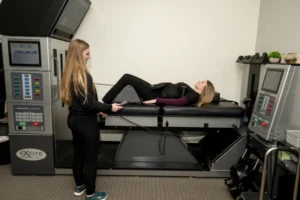
That’s exactly where non-surgical spinal decompression using the DRX9000 system comes in. Rather than cutting into the spine or removing disc material, DRX9000 decompression uses computer-controlled traction to gently separate the vertebrae, reduce pressure inside the disc, and create the conditions your body needs to heal a bulging disc or herniated disc on its own.
The Red Flags That Mean You May Actually Need Surgery
To be direct with our Kansas City, Gladstone, and Liberty patients: there are specific situations where we don’t recommend spinal decompression and instead refer immediately to a spine surgeon or emergency care. These include:
- Loss of bowel or bladder control combined with back pain or leg numbness — this can indicate a rare but serious condition called cauda equina syndrome, which requires emergency surgical evaluation.
- Progressive neurological weakness — if your leg or arm is getting measurably weaker week over week rather than staying the same or improving, that progression needs a surgical opinion.
- Severe, uncontrolled instability in the spine, often from trauma, fracture, or advanced spondylolisthesis.
- Signs of infection or tumor — unexplained fever, unexplained weight loss, or night pain that doesn’t change with position, alongside spinal symptoms.
If any of these apply to you, please seek medical evaluation right away — this article, and spinal decompression in general, is not the appropriate next step. For the large majority of patients who don’t have these red flags, though, a structured trial of conservative care is both appropriate and often exactly what’s needed before surgery is ever seriously discussed.
What Makes Someone a Strong Candidate for Spinal Decompression First
Before recommending the DRX9000, Dr. Ben Dohrmann, Dr. Kevin McFadden, and Dr. Frank Siraguso review your imaging, symptoms, and history together. Good candidates for a non-surgical decompression trial generally include patients with:
- A herniated disc or bulging disc confirmed on MRI or clinically consistent with exam findings
- Degenerative disc disease causing chronic, non-progressive pain
- Mild to moderate spinal stenosis without severe cauda equina symptoms
- Sciatica or radiating leg pain that is stable or intermittent rather than rapidly worsening
- Stable neurological function — meaning strength, reflexes, and sensation aren’t actively declining
- No prior response, or an incomplete response, to physical therapy, medication, or injections
Dr. Dohrmann understands this decision from more than a textbook — he was diagnosed with degenerative disc disease in his own lower back at age 23, long before he became an Olympic Team Chiropractor at the 2012 London Summer Olympics. He knows what it feels like to be told your options are limited, and that lived experience shapes how honestly this practice evaluates every case.
How the DRX9000 Actually Changes the Mechanics of a Disc
Where spinal decompression differs from a standard surgical consult is in what it’s actually trying to accomplish. Surgery typically removes damaged disc material or fuses vertebrae together — a permanent structural change. The DRX9000, by contrast, uses controlled, computer-guided cycles of tension and relaxation to create negative pressure inside the disc itself.
That negative pressure — sometimes called an intradiscal vacuum effect — can draw herniated or bulging material back away from the nerve root, while simultaneously pulling in oxygen, water, and nutrients that the disc needs to repair itself. It’s a fundamentally different strategy than surgery: instead of removing the problem, decompression tries to let your disc heal the problem.
This is also why decompression and surgery aren’t always mutually exclusive on a timeline. Many surgeons want to see documented evidence of a failed conservative treatment trial — including decompression — before authorizing elective spine surgery. In other words, trying decompression first isn’t just about avoiding surgery; for many patients it’s a required or strongly recommended step in the process regardless of where they eventually land.
What a Decompression Trial Actually Looks Like
If you’re a candidate, we don’t ask you to commit to months of treatment on faith. A typical trial period runs several weeks, giving both you and your doctor real data on how your body is responding before deciding on next steps.
During that window, we’re tracking specific, measurable things: Is your leg or arm pain decreasing? Is numbness or tingling improving? Are you regaining range of motion? Are you sleeping through the night? These aren’t vague impressions — they’re the same kind of functional markers a surgeon would want to see before an operation, and they give us (and you) an honest, data-driven answer about whether conservative care is working.
If decompression is doing its job, we continue the plan and often combine it with chiropractic adjustments or SoftWave shockwave therapy to accelerate soft-tissue healing around the disc. If it isn’t working after a genuine trial, that’s valuable information too — and it means a surgical consultation is a reasonable next conversation, not a failure.
Why This Comparison Matters More Than It Seems
Choosing between spinal decompression and surgery isn’t just a medical decision — it’s a financial and lifestyle one. Surgery generally means anesthesia risk, weeks to months of recovery, time away from work, and a permanent structural change to your spine that can’t be undone. Spinal decompression means no incisions, no anesthesia, same-day return to normal activity, and a treatment path that keeps surgical options fully available later if you still need them.
For active patients across Kansas City, Gladstone, Parkville, Liberty, and Smithville — people who want to get back to golfing, gardening, chasing grandkids, or simply sleeping through the night — the ability to try the lower-risk option first, without closing any doors, is often the deciding factor.
Frequently Asked Questions About Spinal Decompression vs. Surgery
Does insurance require me to try spinal decompression before surgery?
Many insurance plans and surgeons do require documentation of a failed conservative care trial — which can include physical therapy, chiropractic care, and spinal decompression — before approving elective spine surgery. Even if it isn’t strictly required in your case, most spine surgeons prefer to see that conservative options were genuinely attempted first.
How do I know if my herniated disc is severe enough to need surgery?
Severity alone doesn’t always determine the need for surgery — function does. Warning signs that point toward a surgical evaluation include progressive weakness, loss of bowel or bladder control, or pain that continues worsening despite conservative care. A large disc herniation that isn’t causing progressive neurological loss can often still respond well to non-surgical treatment like the DRX9000.
Can spinal decompression help if I already had back surgery and still have pain?
Yes, in many cases. Some patients develop ongoing pain after a spinal procedure, sometimes called failed back surgery syndrome. If a disc-related component is still contributing to nerve pressure, a decompression trial may still offer relief, though every case requires individual evaluation.
What if I try spinal decompression and it doesn’t work?
That’s valuable clinical information, not a dead end. If a genuine trial of decompression doesn’t produce meaningful improvement, that outcome helps justify and guide a surgical consultation, and nothing about trying decompression first makes future surgery riskier or less available.
Is spinal decompression covered by insurance the way surgery is?
Insurance coverage for spinal decompression varies and is often more limited than coverage for surgery. Our Kansas City office reviews your specific coverage and offers payment options and financing so cost isn’t a barrier to trying the lower-risk option first.
How long should I try spinal decompression before considering surgery?
Most structured trials run several weeks with treatments a few times per week, which allows enough time to see whether your disc is responding. Your doctor will set clear, measurable checkpoints along the way rather than leaving the timeline open-ended.
Does age affect whether I should choose decompression or surgery?
Age alone doesn’t determine the right path. We’ve successfully treated patients with spinal decompression from their 30s through their 80s. What matters more is your overall bone health, the specific condition involved, and whether any surgical red flags are present.
Can I combine spinal decompression with chiropractic care instead of choosing just one treatment?
Absolutely — and for many patients this combination produces better results than either treatment alone. Decompression addresses pressure on the disc itself, while chiropractic adjustments restore normal movement to the joints above and below the affected area, which often compensate and tighten up when a disc problem is present.
Get an Honest Evaluation Before You Decide
You deserve a clear answer about whether spinal decompression or surgery is the right next step for your spine — not a one-size-fits-all recommendation. At Dohrmann Chiropractic, Dr. Ben Dohrmann, Dr. Kevin McFadden, and Dr. Frank Siraguso bring over 46 years of combined clinical experience and more than 600 five-star Google reviews to every evaluation — and they’ll tell you honestly which path makes sense for your spine.
Serving patients throughout Kansas City, Gladstone, Parkville, Liberty, Smithville, Clay County, and Platte County, our team will review your imaging, walk through your symptoms, and give you a straightforward recommendation, whether that’s spinal decompression, a referral for surgical consultation, or both in sequence.
Dohrmann Chiropractic
9576 N McGee St, Kansas City, MO 64155
Phone: (816) 436-5520
Office Hours:
Monday – Friday: 9:00 AM – 12:00 PM & 2:30 PM – 5:30 PM
Saturday: 9:00 AM – 12:00 PM
Call or text (816) 436-5520 today, or visit our spinal decompression page to schedule your evaluation and find out which path is right for you.